
“Eat more protein” is advice you hear everywhere, from the gym to the GP’s waiting room. But how much is “more”, and more than what? The good news is that you do not need an app or a dietitian’s calculator to get a sensible starting number. One multiplication with your own body weight does the job, and it takes about two minutes.
The quick answer
Multiply your weight in kg by your reference number. Under the Nutrient Reference Values for Australia and New Zealand, adults aged 19–70 need about 0.84 g of protein per kg (men) and 0.75 g per kg (women); after 70 it rises to about 1.07 g (men) and 0.94 g (women). A 70 kg woman, for example, needs around 53 g a day. Spread it over brekkie, lunch and dinner, and if you are trying to lose weight, talk to your GP or a dietitian about whether a higher target suits you.
The formula
Protein a day (g) = your weight (kg) × your reference (g per kg)
Pick your reference from this table. These are the recommended dietary intakes (RDI) published in the Nutrient Reference Values for Australia and New Zealand, the same numbers used on Eat for Health.
| You are | Reference (g per kg a day) | Typical total |
|---|---|---|
| Man, 19–70 | 0.84 | about 64 g |
| Woman, 19–70 | 0.75 | about 46 g |
| Man, over 70 | 1.07 | about 81 g |
| Woman, over 70 | 0.94 | about 57 g |
The “typical total” column is based on a reference body weight. Your own number will be higher or lower depending on what you weigh, which is exactly why the formula is more useful than a one-size figure. Pregnancy and breastfeeding have their own, higher values: ask your GP or midwife.
A worked example, step by step
Let’s take Jess (an illustrative example, not a real reader): 46 years old, 72 kg, desk job in Brisbane, wants to lose a few kilos before Christmas.
- Find the reference.Woman, 19–70: 0.75 g per kg.
- Multiply.72 × 0.75 = 54 g of protein a day. That is her baseline.
- Decide if she wants a buffer.Because she is eating a little less to lose weight, a higher target may help her feel fuller and protect muscle. Research on weight management often uses about 1.2–1.6 g per kg (a review in the American Journal of Clinical Nutrition, 2015). At 1.2 g that would be 72 × 1.2 = about 86 g. She checks that with her GP first.
- Split it across the day.86 g ÷ 3 meals ≈ 29 g per meal, or 54 g ÷ 3 = 18 g per meal for the baseline. Easier to hit in three goes than in one big dinner.
- Turn it into food.Brekkie: two eggs (about 12 g) on wholegrain toast plus a flat white made on milk (a cup of milk adds roughly 7–8 g). Lunch: a tin of tuna or a palm-sized piece of chicken on salad. Dinner: lean meat, fish, tofu or lentils with veg. Snack: a tub of plain Greek yoghurt.
Ready-made table: 4 common cases
Find the row closest to you or copy the maths with your own weight. Protein amounts in foods are approximate; the nutrition panel on the pack is the final word.
| Who | The maths | Daily target | Per meal (3 meals) | A day that gets there |
|---|---|---|---|---|
| Woman, 34, 64 kg | 64 × 0.75 | 48 g | about 16 g | Eggs on toast, a tuna salad, a stir-fry with tofu |
| Man, 52, 88 kg | 88 × 0.84 | 74 g | about 25 g | Yoghurt and oats, a chicken wrap, fish and veg |
| Woman, 73, 66 kg | 66 × 0.94 | 62 g | about 21 g | Scrambled eggs, a lentil soup with cheese, a lamb and veg dinner |
| Man, 75, 80 kg | 80 × 1.07 | 86 g | about 29 g | Eggs and a milky coffee, a ham and salad sandwich plus yoghurt, a beef and veg dinner |
Common protein sources in an Aussie kitchen
- Eggs: roughly 6 g each, cheap and quick.
- Plain Greek yoghurt: often one of the most protein-dense dairy snacks; check the tub, brands vary a lot.
- Milk in your coffee: a milky flat white or latte quietly adds a few grams to your brekkie.
- Tinned tuna, salmon and chickpeas: pantry staples for fast lunches.
- Chicken, lean beef, lamb and fish: a palm-sized portion covers a big part of one meal.
- Lentils, beans and tofu: protein plus fibre, which makes them doubly filling.
Short on breakfast ideas? Our healthy brekkie ideas with your morning coffee are all built on protein and fibre, and the 48-hour meal prep plan shows how to have protein-packed lunches ready for the week.
Why protein matters when you are losing weight
Protein is the most filling of the three macronutrients, and it helps your body hang on to muscle while you eat a little less. That is why a protein-light brekkie (toast and jam, a pastry with your coffee) so often ends in a 10 am raid on the biscuit tin. The second piece of the fullness puzzle is fibre, which slows digestion and keeps you satisfied for longer. Most Aussies do not get enough of either at breakfast.
That is where your morning coffee can pull its weight. Akemi Coffee Boost does not add protein, but it adds two soluble fibres (psyllium husk and resistant dextrin) to the flat white or long black you already drink, with no change in taste. Protein on the plate plus fibre in the cup is a simple, low-effort combination for a fuller morning.
When to get personal advice
The formula gives you a sensible everyday number, not a prescription. Speak with your GP or an accredited practising dietitian before raising your protein a lot if you have kidney disease, diabetes, liver problems, are pregnant or breastfeeding, or follow a very restricted diet. And if you are over 70, ask about strength exercises too: protein works best for muscle when your muscles also have some work to do.
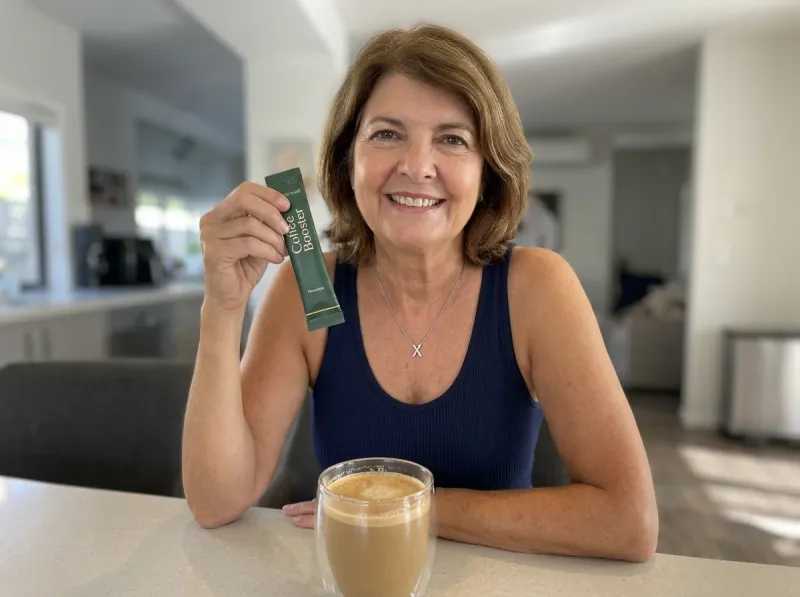
Our recommendation: Akemi Coffee Boost
Once you know your protein number, the next step is making the whole morning work for you. Akemi Coffee Boost is the option we recommend to sit alongside a protein-friendly brekkie: it turns the coffee you already drink into a source of fibre for fullness, so the gap between breakfast and lunch feels a lot shorter.
- Fibre for fullness. Psyllium husk and resistant dextrin, the perfect partner for the protein on your plate.
- Steadier blood sugar. White kidney bean and mulberry leaf support you after carb-heavy meals, so cravings have less pull.
- Gentle energy. Green tea, green coffee bean and L-carnitine, with only about 30 mg of natural caffeine per sachet.
- Zero effort. Flavourless and odourless; it dissolves in a flat white, long black, instant coffee, tea or water.
On the official Australia & New Zealand order page: 1 box $29.99, 2 boxes $49.98 ($24.99 each) or 3 boxes $59.97 ($19.99 each, about a dollar a day). It is a one-off purchase with no subscription, shipping is calculated at checkout and every order has a 30-day money-back guarantee. Customers rate it 4.8/5 across 3,758 reviews.
This article is general information and does not replace advice from your GP or an accredited practising dietitian. If you are pregnant, breastfeeding, taking medication or managing a health condition, talk to your GP before adding any supplement to your routine.
Frequently asked questions
How much protein do I need a day in Australia?
The Nutrient Reference Values for Australia and New Zealand set the recommended dietary intake for adults aged 19 to 70 at about 0.84 g per kg of body weight for men (around 64 g a day) and 0.75 g per kg for women (around 46 g a day). Multiply your own weight in kilograms by your number to get your personal target.
Do I need more protein after 70?
Yes. For people over 70 the reference rises to about 1.07 g per kg for men (around 81 g a day) and 0.94 g per kg for women (around 57 g a day), mainly to help hold on to muscle. Dietitians Australia often rounds this to about 1 g per kg.
Should I eat more protein when I am trying to lose weight?
Protein helps you feel full and protects muscle while you eat a little less. Weight-management research often uses around 1.2 to 1.6 g per kg, which is above the basic reference. Talk to your GP or an accredited practising dietitian before going high, especially if you have kidney disease.
How much protein is in two eggs?
Two eggs give you roughly 12 g of protein. A tub of plain Greek yoghurt, a palm-sized piece of chicken or a tin of tuna each add considerably more, so check the nutrition panel on the pack for the exact figure.
Is it better to eat protein at breakfast?
Spreading protein across the day works better for most people than saving it all for dinner. A protein-friendly brekkie also helps keep mid-morning hunger and the arvo snack attack quieter.
Does Akemi Coffee Boost contain protein?
No. Akemi Coffee Boost is a flavourless coffee sachet with two soluble fibres, plant extracts and about 30 mg of natural caffeine. It works alongside a protein-friendly breakfast: the protein comes from your plate, the extra fibre for fullness comes from the sachet in your coffee.
Got your protein number? Pair that protein-friendly brekkie with a sachet of Akemi Coffee Boost in your morning flat white for fibre that helps you stay full until lunch.